
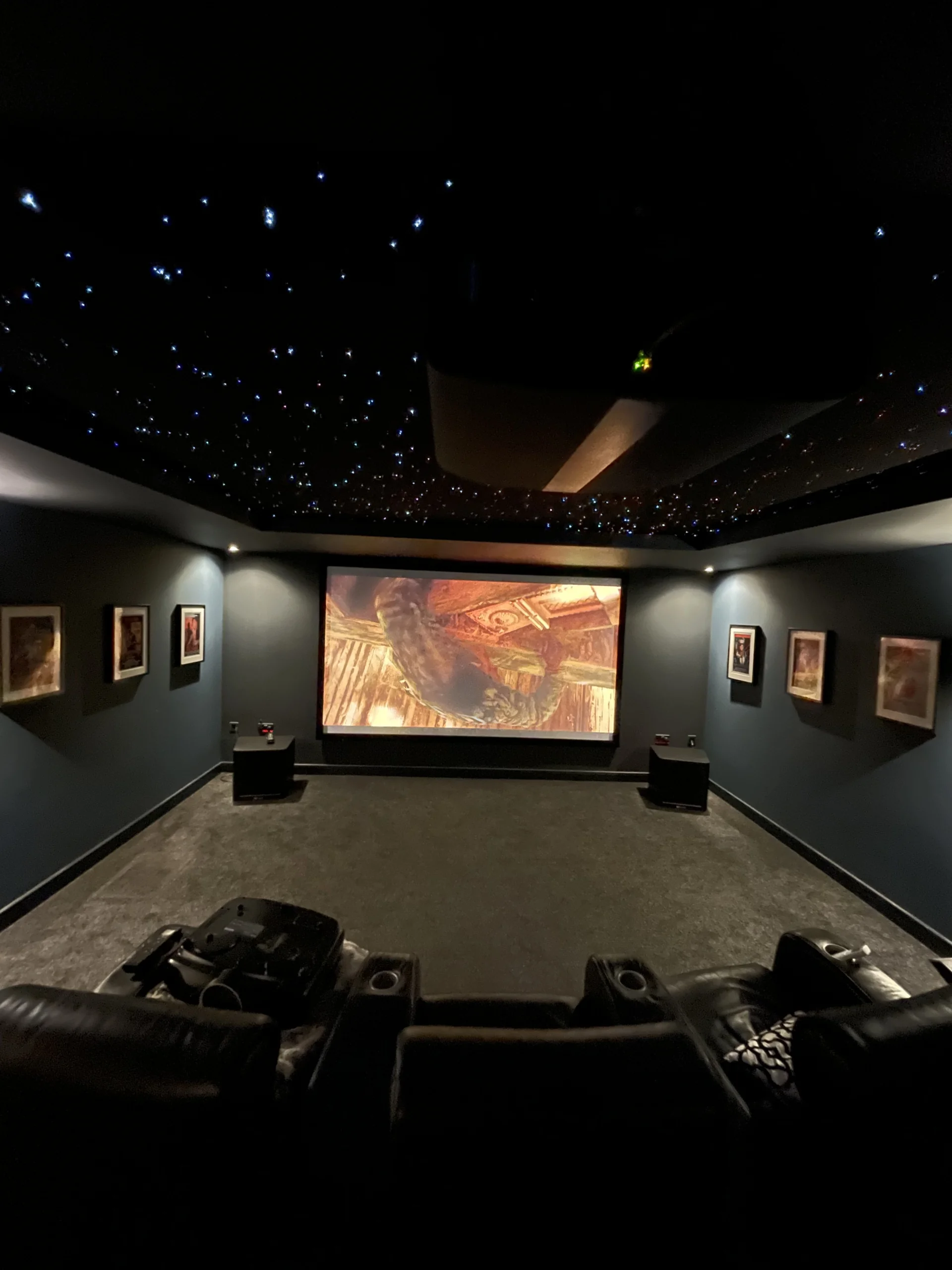
A home cinema is not a large television in a dark room. At its best, it is an immersive environment purpose-built for the faithful reproduction of cinema — where the acoustics, the optics, and the control systems work in concert to deliver an experience that rivals commercial screening rooms. At MK Iconic Solutions, we have designed and installed cinema rooms across the UK, UAE, and United States, and the principles that guide every project remain constant: acoustics first, calibration always, and integration everywhere.
Why Are Acoustics the Most Important Factor in Home Cinema?
The single most important factor in home cinema performance is the room itself. Dimensions, materials, furnishings, and surface treatments all influence how sound behaves. Parallel walls create standing waves that produce boomy, uneven bass. Hard surfaces cause reflections that smear dialogue clarity. Untreated rooms can lose up to 40% of the detail encoded in a modern surround soundtrack.
A professional integrator analyses these variables and designs acoustic treatments that optimise the space. Bass traps in corners tame low-frequency build-up. Absorption panels at first-reflection points prevent dialogue-smearing early reflections. Diffusion panels on the rear wall create an enveloping surround field without the dead, studio-like quality that over-absorption produces. The goal is a room that enhances the soundtrack rather than fighting it — ensuring dialogue clarity, controlled bass, and an immersive surround field that places you inside the content.
Should You Choose a Projector or LED for Home Cinema?
The choice between projection and a large-format display is one of the first decisions in cinema design. For dedicated cinema rooms with controlled lighting, a 4K laser projector paired with an acoustically transparent screen delivers the most authentic cinematic experience. Screen sizes of 120 to 150 inches are common, with 4K laser projectors from Sony, JVC, and Epson offering brightness levels and contrast ratios that were unimaginable five years ago.
For multi-purpose rooms where ambient light control is limited, a high-end LED display — such as the Samsung Neo QLED or Sony Bravia XR range in 85 to 98-inch configurations — may be more appropriate. Modern mini-LED and OLED panels offer exceptional contrast and brightness even in daylit rooms, making them excellent choices for family spaces that serve dual duty as living areas and entertainment zones. We assess each room's lighting conditions, usage patterns, and client preferences before recommending the optimal display technology.
Calibration Is Non-Negotiable
A 4K laser projector is only as good as its calibration. Professional installers use reference-grade measurement tools to calibrate colour accuracy, contrast ratio, black levels, and geometry to ISF (Imaging Science Foundation) standards. The human eye is remarkably sensitive to colour temperature variations, and even a minor miscalibration can make skin tones appear unnatural or night scenes look washed out.
Audio receives the same treatment. Every speaker is tuned, time-aligned, and level-matched to deliver a reference-quality soundstage from the primary listening position. In a Dolby Atmos configuration — typically 7.1.4 or 9.1.6 for our installations — each of the overhead height channels must be calibrated to create a convincing hemisphere of sound. We use measurement microphones and room correction software to ensure the final result meets or exceeds the Dolby reference standard. The difference between a calibrated system and an uncalibrated one is not subtle — it is the difference between hearing a soundtrack and being inside it.
Seating Geometry: Every Seat Is the Best Seat
Professional cinema design considers viewing angles, screen-to-seat distance, and tiered seating to ensure every position in the room delivers an optimal experience. The THX viewing angle recommendation of 36 degrees guides screen size relative to the primary row. A secondary raised row, when room dimensions allow, provides unobstructed sightlines and a slightly different acoustic perspective that many viewers prefer.
Seating selection itself is an important consideration. Dedicated cinema recliners from manufacturers like Fortress Seating and Salamander Designs offer motorised recline, USB charging, LED cup-holder illumination, and integrated bass transducers that add a tactile dimension to low-frequency effects. The seating plan is designed to ensure every position is within the projector's optimal throw range and within the audio system's sweet spot — there is no "bad seat" in a properly designed home cinema.
Concealed Infrastructure: Technology Disappears
Equipment racks, amplifiers, processors, and cable management are housed in dedicated spaces — often in a separate plant room, utility cupboard, or purpose-built rack closet adjacent to the cinema. The cinema itself presents nothing but the screen, the speakers (often concealed behind acoustically transparent fabric), and the seating. The technology disappears. The experience remains.
This approach serves multiple purposes. It removes fan noise and heat from the viewing environment. It simplifies maintenance — all equipment is accessible without disturbing the cinema. And it allows equipment to be shared with other zones: the same processor that powers the cinema's Atmos system can distribute stereo audio to adjacent rooms when the cinema is not in use.
One-Touch Operation: The Cinema Scene
When integrated with Control4, launching a cinema session is a single action. The lights dim on a three-second fade. The shades descend silently. The projector ignites, the screen lowers from its ceiling recess, the AV receiver configures to Dolby Atmos, and your streaming library appears on the screen — all from a single button press on a Halo remote or a Control4 touch screen. Pausing the film raises the lights to a warm intermission glow. Stopping it returns the room to its default state. This is automation at its most purposeful — technology serving the experience rather than complicating it.
Does a Home Cinema Increase Property Value?
A professionally installed home cinema is a significant differentiator in the premium property market. Estate agents consistently report that a well-executed cinema room adds measurable value to a property — and more importantly, it is a feature that prospective buyers remember long after viewing dozens of properties. For families, a home cinema becomes the most-used room in the house — film nights, sports events, gaming sessions, and music listening sessions fill it with life week after week, year after year. It is not a luxury. It is an investment in how you live.
Frequently Asked Questions
What size room do I need for a home cinema? A dedicated cinema can be designed for rooms as small as 3.5m x 5m, though larger spaces allow for more ambitious screen sizes and tiered seating. For a single-row cinema with a 120-inch screen, a room depth of approximately 4.5 metres is ideal. We have designed cinemas ranging from compact converted bedrooms to purpose-built 60-square-metre screening rooms — the principles of acoustic treatment, calibration, and one-touch operation apply regardless of scale.
Projector or large TV — which is better? For dedicated rooms with full light control, a 4K laser projector with an acoustically transparent screen delivers the most cinematic experience at screen sizes above 100 inches. For multi-purpose rooms with ambient light, a high-end LED display (85-98 inches) offers superior brightness and contrast without requiring blackout conditions. We assess each room's characteristics and recommend the technology that delivers the best experience for that specific environment.
How much does a professional home cinema cost? Every cinema we build is bespoke and priced by consultation. A high-quality single-row room with 4K projection and Dolby Atmos surround is a very different build from a reference-grade room with M&K Sound speakers, tiered seating, acoustic treatment, and full automation. We design to your room, your preferences, and your budget — and confirm a personalised proposal after a site survey.